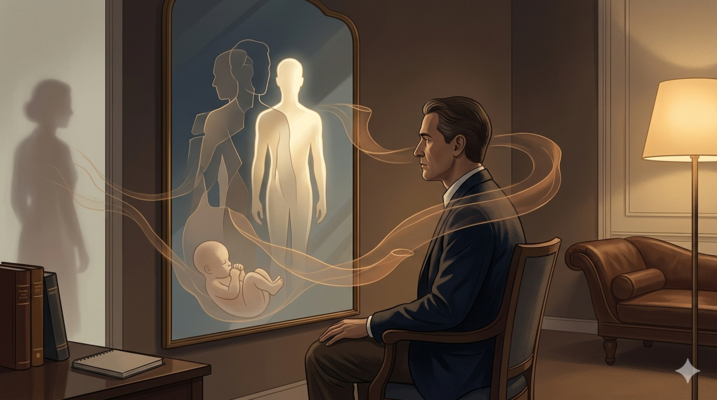
As an analytic therapist, I have met this question many times in the consulting room. Having done something — having, say, put himself before another, made a choice in which the other's role grew faint, or pursued some idealized image of himself — the patient turns to me and asks: "Does that mean I'm a narcissist?"
In that moment, my mind goes at once to the first reading I ever had of narcissism in psychoanalysis: Freud's essay "On Narcissism: An Introduction," written in 1914. And each time I arrive at the same conclusion — that what lies hidden in the patient's question is separated by a fundamental distance from what Freud meant by the concept.
The first thing to clarify is that Freud presented narcissism not as a label or a fixed trait — something you either are or aren't — but as something developmental. In his view, narcissism is present in us from the very beginning and merely changes its forms over the course of a life. For this reason, the right question is not "to be or not to be a narcissist"; the right question is how narcissism works in the different periods of our lives, and what shape it takes.
Freud’s Revolutionary View of Narcissism: From Perversion to Development
To see the significance of Freud's move, we have to look at where he began. Before Freud, writers such as Näcke and Havelock Ellis used the term to describe a kind of perversion: a person who takes his own body as a sexual object and treats it as one would ordinarily treat the body of another.
Freud's revolutionary step was taken precisely here: he pulled narcissism out of that narrow clinical-perversion frame and turned it into a normal and universal stage of development — what he calls "the libidinal complement to the egoism of the instinct of self-preservation." On this reading, primary narcissism is the original investment of libido in the self; a stage that exists before we acquire the capacity to love another (an object). Narcissism is no longer an illness or a perversion; it is a station every one of us has passed through.
Secondary Narcissism and Psychosis in Freud’s Theory
Part of the evidence Freud brings for the concept comes from the domain of psychosis (what he called "paraphrenia," and what we today place close to schizophrenia). In psychosis, the person withdraws his libidinal interest from the external world and from people, and turns it back toward himself; the result of this return can be seen in megalomania and delusions of grandeur.
But here is the subtle point: this narcissism is not the same as the infant's primary narcissism. It is libido that first went out toward objects and was then withdrawn from them and brought home — back to the self. Freud calls this secondary narcissism. Narcissism thus reveals itself at the two ends of a life: at the dawn of existence, and at the moment when the person's bond with the world comes apart.
Libido, Ego-Libido, and Object-Libido
To understand this coming-and-going, we have to bring in the concept of libido. Libido is the psychic energy of the drives of love and desire. Freud proposes an economic model: there is a definite quantity of libido that is distributed between two poles — ego-libido (invested in the self) and object-libido (invested in the other). Between the two there is an inverse relationship: the more is allotted to one, the less remains for the other; rather like communicating vessels, or like the image Freud himself uses — an amoeba whose body is the "self" and which extends pseudopodia toward objects, pseudopodia it can withdraw again whenever it wishes.
This is where Freud's lovely examples come into play. He speaks of an attraction we feel toward self-sufficient beings: the cat that seems to take no notice of us, the child absorbed in his own self-containment, or that "omnipotence of thoughts" by which the child (and, in Freud's terms, "primitive" peoples) believes his wishes and thoughts can shape the world. We are drawn to these self-contained beings as if envying a narcissistic completeness we ourselves have had to give up. And it is within this same frame that Freud rereads parental love: "His Majesty the Baby" is nothing other than the rebirth of the parents' own narcissism in the child.
The Ego-Ideal: How Narcissism Survives in Adult Life
And now the decisive question: what becomes of this primary narcissism as we grow? Freud's answer is that narcissism does not simply disappear, and we do not "outgrow" it. The demands of culture, of reality, and of others compel the ego to relinquish that original sense of perfection. But the ego does not surrender that perfection willingly; rather, it displaces it.
The ego sets up an ideal within itself -the ego -ideal- and places before itself an image of what it ought to be. This ideal is in truth the heir of childhood narcissism; in Freud's own words, what a man projects before him as his ideal is the substitute for the lost narcissism of his childhood, the time when he was his own ideal. In this way narcissism survives - but in disguise, displaced into the ego-ideal - and our self-regard becomes a measure of the distance between the actual ego and this ideal.
Alongside this ideal there also forms a self-observing, self-judging agency that continually keeps the ego under watch and measures it against the ideal; the very thing Freud would later, in 1923, name the superego. In this sense, "On Narcissism" already carries within it the seed of one of the most central concepts of his later theory.
So, Am I a Narcissist?
Now let us return to the patient who asks, "Am I a narcissist?" From the vantage of this reading, the question is in a way ill-posed. Narcissism is not a coat we either put on or leave off; it is a current that runs through every life and only changes its forms — from the self-sufficient paradise of the infant, to the idealization of the lover, to the ideals against which we measure ourselves.
Just for this reason, the right question is not whether narcissism exists in us — it always does — but rather what its developmental fate has been, and through what paths it has survived and to what extent it continues to work within us.